A week defined by surprises and enforcement. An anonymous AI video model quietly topped the global benchmark leaderboard on April 7, then Alibaba admitted it was theirs three days later. Seedance 2.0 quietly arrived in US CapCut — a significant development given the IP standoff that surrounded its global rollout. And the TAKE IT DOWN Act, signed into law ten months ago, produced its first criminal conviction.
Models covered: HappyHorse · Veo 3.1 · Seedance 2.0 · Regulation
🐴 Alibaba’s Anonymous Model Tops the Leaderboard — Then Takes Off Its Mask
Around April 7, an unidentified model called HappyHorse-1.0 appeared on the Artificial Analysis AI video benchmark arena and immediately climbed to first place in both text-to-video and image-to-video categories. No company affiliation, no press release, no social media presence. Just results.
In the text-to-video (no audio) category, HappyHorse-1.0 scored 1,333 Elo — surpassing ByteDance’s Seedance 2.0, which had held the top position, by roughly 60 points. In image-to-video (no audio), it reached 1,392 Elo. The rankings are based on blind human preference testing — head-to-head comparisons where evaluators don’t know which model produced which clip. HappyHorse won those comparisons at a rate that put it in a category of its own.
On April 10, a newly created X account identified the developers as the ATH AI Innovation Unit, a recently formed business group inside Alibaba called Alibaba Token Hub. The model is described as still under internal beta testing. No weights have been publicly released; the GitHub and model hub pages listed on the project’s website both show “coming soon.” The team confirmed it will be fully open-sourced. A live demo is available through the Artificial Analysis arena for anyone who wants to test it.
The three-day gap between appearance and attribution was almost certainly deliberate. Entering the benchmark anonymously meant the model was judged purely on output quality, without the reception distortions that come with a high-profile company launch. Whether the strategy reflects unusual confidence or strategic communication — or both — the results speak for themselves.
Why it matters: Seedance 2.0 had held the top position on Artificial Analysis since early 2026 and was widely considered the quality leader in the commercial tier. HappyHorse-1.0 displacing it — from inside Alibaba, with no prior announcement — is the most significant benchmark shift in several months. It also signals that Alibaba’s AI video effort runs deeper than the publicly tracked Wan model line. When the weights are released, this will be a major event for the open-source community.
🇺🇸 Seedance 2.0 Arrives in US CapCut — With Guardrails
The AI video industry’s most consequential unresolved question through March and early April was whether ByteDance would actually deploy Seedance 2.0 to US users given the active IP disputes with Hollywood studios including Disney, Paramount, Warner Bros., and Netflix. This week, ByteDance answered it: Dreamina Seedance 2.0 is now rolling out to US CapCut users.
The deployment comes with significant content restrictions. ByteDance has disabled image-to-video generation from any input containing real faces — a direct response to the copyright and likeness concerns raised by studios and SAG-AFTRA. The system also blocks generation of content that reproduces unauthorized intellectual property. All output carries an invisible watermark to allow off-platform identification.
The rollout is phased and may not yet have reached all US CapCut accounts. The earlier global expansion touched Brazil, Indonesia, Malaysia, Mexico, the Philippines, Thailand, and Vietnam before expanding further across Africa, South America, the Middle East, and Southeast Asia. The US deployment appears to be following the same staged approach.
Why it matters: For US creators, this is meaningful access to a model that has benchmarked at the top of the field for months — embedded in a platform with a massive base of existing CapCut users. The face-generation restriction is a real limitation for certain use cases, but the overall capability set remains strong. For Hollywood, the restrictions represent a partial negotiating win, though the underlying copyright questions around training data remain unresolved and in active litigation.
⚖️ TAKE IT DOWN Act Gets Its First Conviction
On April 8, a federal court in Ohio secured the first criminal conviction under the TAKE IT DOWN Act — the federal law targeting non-consensual intimate imagery including AI-generated deepfakes, signed by President Trump in May 2025.
James Strahler, 37, of Columbus, Ohio, pleaded guilty to charges that included generating and distributing more than 700 illicit AI-generated images. Strahler had installed over 24 AI applications and used more than 100 web-based generation tools during the period covered by the charges, which ran from December 2024 through June 2025. The material targeted six adult women and depicted minors in sexually explicit contexts. Under the Act, convictions carry up to two years imprisonment for adult victims and up to three years when minors are depicted.
The TAKE IT DOWN Act requires that by May 19, 2026, covered platforms comply with notice-and-takedown obligations for intimate visual depictions and deepfakes — a compliance deadline now six weeks away. Forty-six states have enacted legislation targeting AI-generated media in some form, though enforcement density and scope vary widely.
Why it matters: Laws without enforcement are policy theater. This conviction establishes the first real precedent under the federal statute — and it arrives 10 weeks before the platform compliance deadline. The May 19 date will test whether major hosting and social platforms have the systems in place to comply. For AI video developers, the conviction is a reminder that content safety restrictions aren’t just brand risk management: they’re now a legally enforced boundary.
💸 Google Cuts Veo 3.1 Fast Pricing as Promised
Google followed through this week on the commitment made during the Veo 3.1 Lite launch: Veo 3.1 Fast pricing was reduced on April 7, compressing the full developer tier stack simultaneously. The cut is significant relative to the March baseline — Veo 3.1 Fast had been priced at $0.15 per second for 720p and 1080p — though exact post-April 7 per-second rates were not confirmed at press time. Developers are advised to check the Gemini API pricing documentation directly.
With Veo 3.1 Lite at $0.05 per second for 720p and the Veo 3.1 Fast cut confirmed on top of that, Google now presents a three-tier developer offering from free consumer access through Google Vids up to full-quality production-grade API calls. The pace of compression — a new model tier and a price cut in the same week the prior week’s infrastructure move landed — suggests Google is treating Veo as a volume acquisition play, not a margin-protection play.
Why it matters: When the dominant provider of a category cuts prices this aggressively, it either prices out competitors or forces a response. Runway, Kling, and Luma all have developer-facing API pricing that now faces direct pressure from a better-capitalized competitor. This is the second consecutive week Google has made pricing moves that force a reaction across the field.
📈 By the Numbers
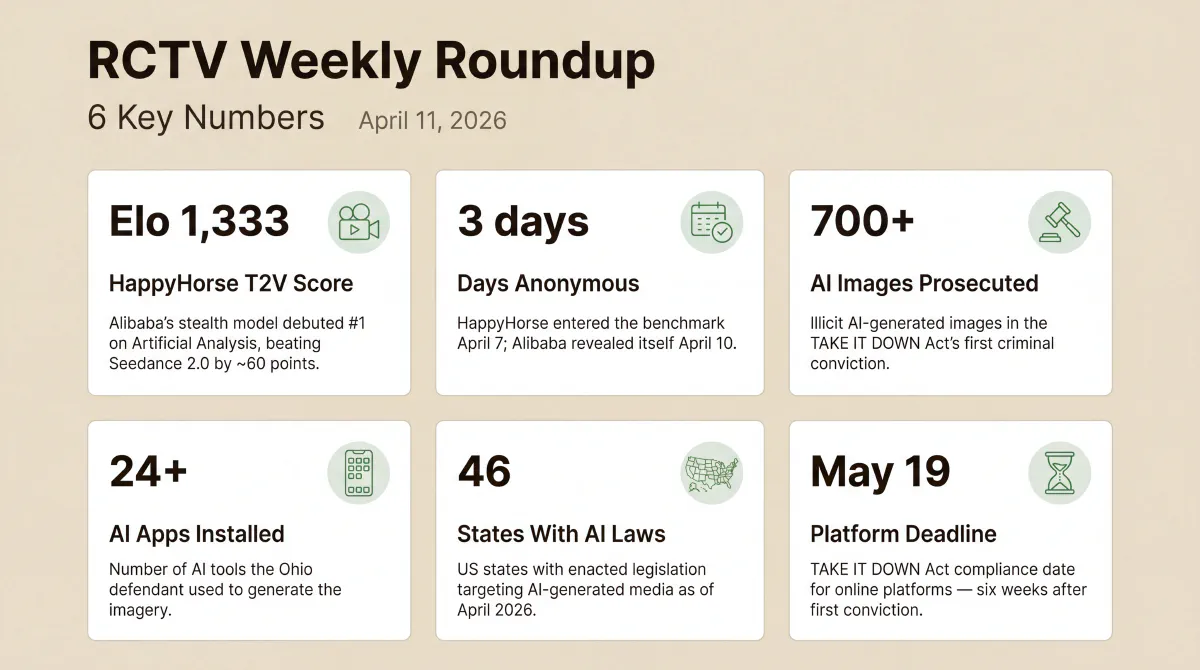
- Elo 1,333 — HappyHorse-1.0’s text-to-video benchmark score, the new #1 on Artificial Analysis — surpassing Seedance 2.0 by ~60 points
- 3 days — Time from HappyHorse-1.0 entering the Artificial Analysis arena anonymously (April 7) to Alibaba revealing itself as the developer (April 10)
- 700+ — AI-generated illicit images produced by the defendant in the first TAKE IT DOWN Act conviction
- 24+ — AI applications installed by the Ohio defendant to generate the imagery
- 46 — US states with enacted legislation targeting AI-generated media as of April 2026
- May 19 — TAKE IT DOWN Act platform compliance deadline — six weeks from this week’s first conviction
🔮 What to Watch Next Week
- HappyHorse weights release — The ATH team said open-source weights are “coming soon.” Any release in the next 7-14 days would immediately become the top open-source video model and is worth monitoring closely
- Veo 3.1 Fast confirmed pricing — Google’s developer docs will reflect the actual new per-second rate; watch whether the cut changes adoption curves in API dashboard data
- TAKE IT DOWN Act platform compliance — May 19 is six weeks out and the Strahler conviction raises the profile of the deadline; expect platform policy announcements from major hosts in the run-up
For full specs, pricing, and access details on every model covered this week, see the AI Video Generation Tools 2026 reference page — updated every Friday.